
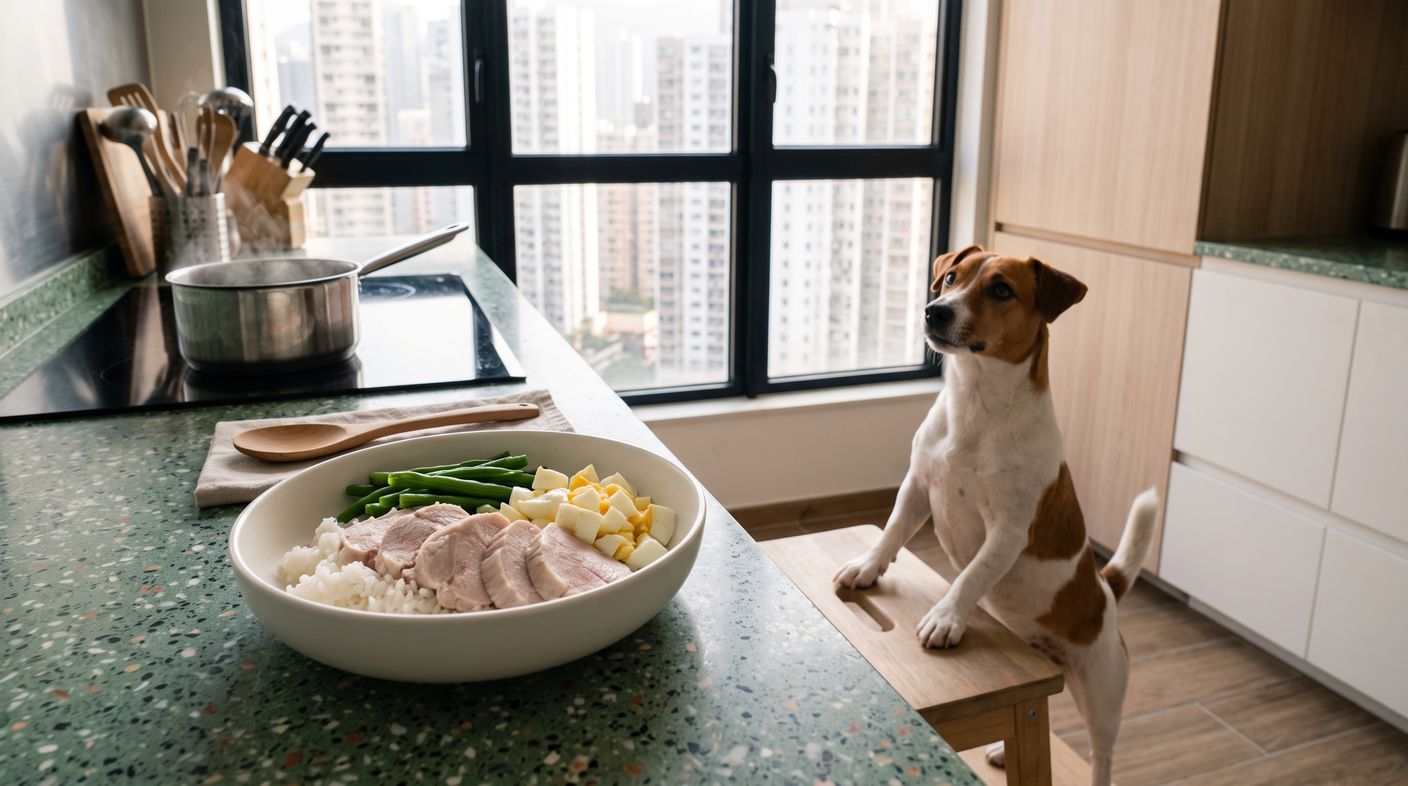

Plenty of owners strike pork off the list entirely after a pancreatitis diagnosis. What needs striking off is fatty pork. Tenderloin is the leanest cut on the animal, comparable to chicken breast, and every wet market has it.
This recipe belongs to the recovery (ultra low fat) group. Fat is held at 15 g per 1000 kcal, against roughly 40 to 60 g in an ordinary adult food, so about a third. Dietary fat is the main trigger for pancreatitis, which makes fat control the whole basis of the diet. Protein is 96 g from lean, high biological value sources, the carbohydrate is highly digestible white rice, and dietary fibre sits at just 4.2 g, a low-residue design that asks less of the gut.
Ingredients (standard batch)
| Ingredient | Amount | Preparation |
|---|---|---|
| Pork tenderloin | 1.95 kg | diced, all visible fat removed |
| White rice | 600 g | rinsed |
| Green beans | 400 g | cut into short lengths |
| Egg white | 200 g (about 6 egg whites) | whites only – yolks are high in fat |
| Sunflower oil | 15 g (about 3.3 tsp) | stirred in off the heat – measure it exactly |
This batch yields about 3.6 kg (about 4,506 kcal).
Method
- Put the white rice in a large pot, cover with water, bring to a boil and simmer for 12 minutes.
- Add the pork tenderloin and cook for 10 to 12 minutes until fully cooked through. Poach it – never fry.
- Add the green beans and cook a further 5 minutes until tender.
- Beat the egg whites, take the pot off the heat and pour them in slowly while stirring, so they set into soft strands in the residual heat.
- Stir in the sunflower oil. Measure it properly with a spoon – it is the only added fat in the recipe, and any extra pushes the fat level up.
- Cool with the cooking liquid included, then portion: 3 days in the fridge, the rest frozen.
Nutrient analysis (per 1000 kcal, before supplements)
| Item | Per 1000 kcal | Reference |
|---|---|---|
| Fat | 15 g | cap for this group 18 g (ordinary food 40 to 60) |
| Crude protein | 96 g | AAFCO minimum 45 g |
| Carbohydrate | 112 g | – |
| Dietary fibre | 4.2 g | low residue, easy to digest |
| Linoleic acid (essential fatty acid) | 3.7 g | AAFCO minimum 3.3 g |
| Calcium / phosphorus | 1,250 / 1,000 mg | Ca:P 1.25:1 |
With Eggshell Calcium Powder (about 3.0 g per 1000 kcal) and Daily Multi for Dogs (about 7.9 g per 1000 kcal), this recipe meets every minimum in the AAFCO adult maintenance profile and can be fed as an everyday diet. That is the key difference from a renal diet: pancreatitis asks you to control fat and nothing else has to be compromised. The sunflower oil is measured to meet the essential fatty acid (linoleic acid) minimum, so please do not leave it out.
Feeding and supplement dosing (two meals per day)
| Dog weight | Daily energy need | Daily food | Batch lasts | Daily Multi (per meal) | Eggshell Calcium (per meal) |
|---|---|---|---|---|---|
| 3 kg | 251 kcal | about 200 g | about 18 days | 1.0 g | 0.4 g (about 1/8 tsp) |
| 5 kg | 368 kcal | about 300 g | about 12 days | 1.5 g | 0.6 g (about 1/4 tsp) |
| 10 kg | 619 kcal | about 500 g | about 7 days | 2.4 g | 0.9 g (about 3/8 tsp) |
| 20 kg | 1,040 kcal | about 840 g | about 4 days | 4.1 g | 1.6 g (about 5/8 tsp) |
| 30 kg | 1,410 kcal | about 1,140 g | about 3 days | 5.6 g | 2.1 g (about 7/8 tsp) |
Important notes
- Fat is the whole point of a pancreatitis diet. Add no oil beyond the sunflower oil specified in the recipe, and no butter, fatty meat, skin, organ meat, cheese or dairy. A single accidental high-fat meal is enough to trigger a relapse.
- Feed small, frequent meals: three or four a day asks less of the pancreas than two. The table below assumes two meals a day, so halve each portion if you feed four.
- An acute flare-up needs a vet, immediately – vomiting, abdominal pain, a hunched posture, refusing food. These recipes are for recovery and long-term management, not for an acute episode.
- Breeds prone to high blood lipids, such as miniature schnauzers and poodles, benefit most from staying on a low-fat diet long term.
- Transition over 7 days, watching for vomiting, diarrhoea, appetite and general demeanour.
- Recheck pancreatic lipase (cPLI) and triglycerides periodically, and adjust the fat level on your vet’s advice.
- These recipes are formulated for adult dogs at a healthy weight. If your dog has another condition such as kidney disease or diabetes, speak to your vet first.
No time to cook every week? Dogalicious Pancreas Digestive Care therapeutic fresh food is built on the same low-fat principles, nutritionist formulated and ready to heat and serve. The supplements this recipe needs: Daily Multi for Dogs and Eggshell Calcium Powder.