
Pancreatitis Dog Food Recipes – 20 Low Fat Homemade Meals
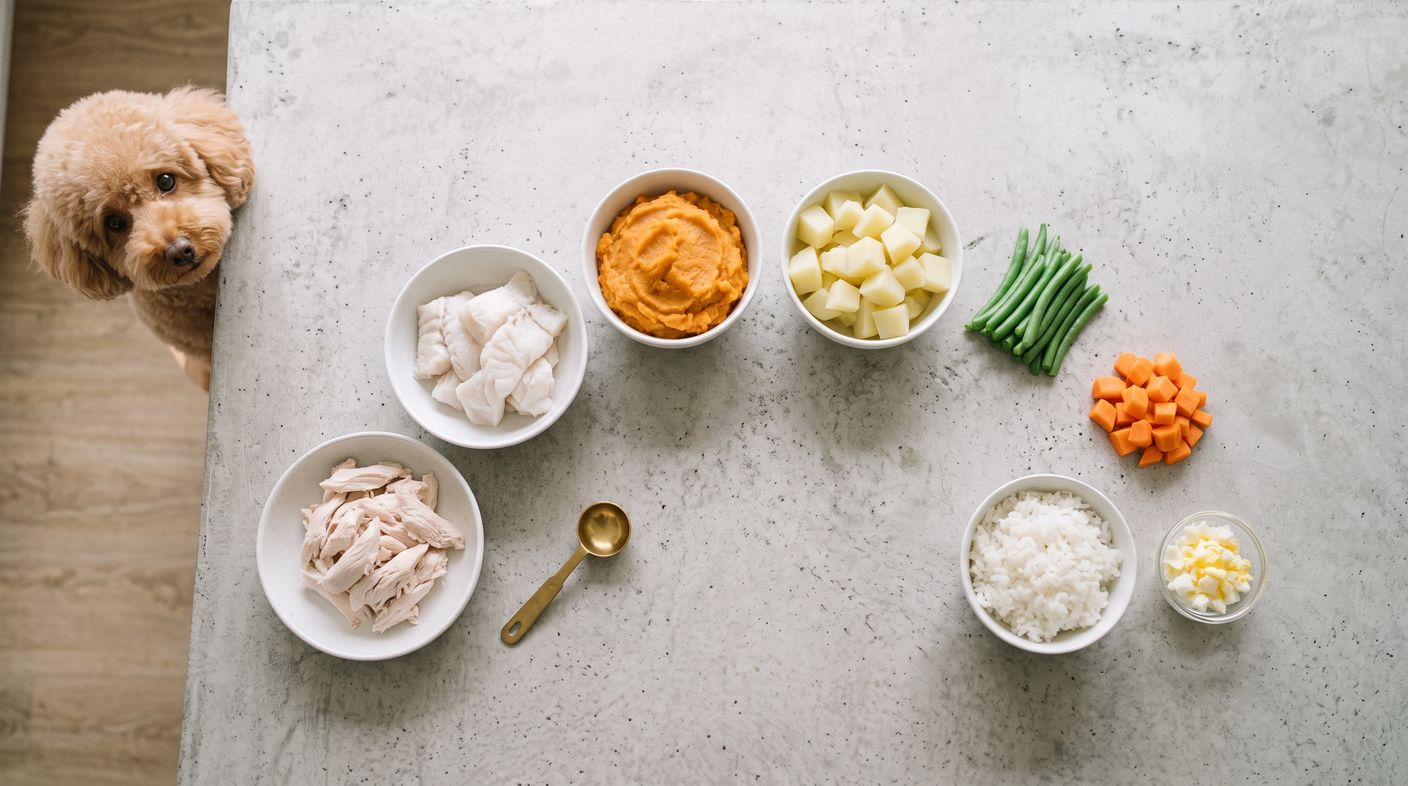
“Low fat from now on.” For most owners that is the sentence they walk out of the clinic with, and it is usually where the advice stops. How low is low? Which meat at the wet market is safe? Will a home-cooked bowl even be balanced? This page puts numbers to all of it, then gives you 20 recipes you can cook in a Hong Kong kitchen.
The thing that matters is fat. Dietary fat is the main factor that triggers and perpetuates pancreatitis, so fat control is the basis of the entire diet. An ordinary adult food carries roughly 40 to 60 g per 1000 kcal. The recovery recipes here run 14 to 18 g and the long-term recipes 18 to 24 g.
The second point matters just as much: pancreatitis asks you to control fat, and nothing else has to be compromised. Fed with the two supplements, all 20 recipes meet every minimum in the AAFCO adult maintenance profile and can be fed as an everyday diet. That is a genuine difference from a renal diet, which has to depart from the profile deliberately. This one does not.
An acute flare-up needs a vet, immediately. These recipes are for recovery and long-term management, not for an acute episode with vomiting, abdominal pain, a hunched posture or refusal to eat. Check with your vet before starting any new diet.
What the two supplements are doing
Daily Multi for Dogs supplies the vitamins and trace minerals a home-cooked bowl runs short of, at a dose that differs by recipe (roughly 6 to 13 g per 1000 kcal). Eggshell Calcium Powder supplies calcium and holds the calcium to phosphorus ratio in range, which sits at 1.20 to 1.25:1 across this book. Together they are what make the recipes complete.
Every recipe also includes a small measured amount of sunflower oil. That sounds like a contradiction in a low-fat diet, but it is not: dogs need essential fatty acids, AAFCO requires at least 3.3 g of linoleic acid per 1000 kcal, and very lean meat does not supply enough. Sunflower oil is high in linoleic acid, so it meets the requirement with very little total fat. Measure it properly and do not leave it out.
Recovery recipes (ultra low fat, 14 to 18 g per 1000 kcal)
For dogs recently recovered, prone to repeat flare-ups, or where your vet has asked for strict fat restriction.
- Chicken Breast and Potato (Pancreatitis Recovery) – fat 15 g, protein 130 g per 1000 kcal
- Turkey Breast and Sweet Potato (Pancreatitis Recovery) – fat 16 g, protein 140 g per 1000 kcal
- Cod and Rice (Pancreatitis Recovery) – fat 14 g, protein 88 g per 1000 kcal
- Pollock and Potato (Pancreatitis Recovery) – fat 14 g, protein 139 g per 1000 kcal
- Seabass and Rice (Pancreatitis Recovery) – fat 14 g, protein 89 g per 1000 kcal
- Venison and Sweet Potato (Pancreatitis Recovery) – fat 18 g, protein 139 g per 1000 kcal
- Pork Tenderloin and Rice (Pancreatitis Recovery) – fat 15 g, protein 96 g per 1000 kcal
- Chicken and Egg White with Potato (Pancreatitis Recovery) – fat 15 g, protein 135 g per 1000 kcal
- Cod and Egg White with Sweet Potato (Pancreatitis Recovery) – fat 18 g, protein 138 g per 1000 kcal
- Turkey and Egg White with Potato (Pancreatitis Recovery) – fat 14 g, protein 137 g per 1000 kcal
Long-term management recipes (low fat, 18 to 24 g per 1000 kcal)
The everyday diet once things are stable. A little more relaxed than the recovery half, and still far below an ordinary food.
- Chicken Breast and Sweet Potato (Low Fat Long Term) – fat 20 g, protein 139 g per 1000 kcal
- Turkey Breast and Potato (Low Fat Long Term) – fat 20 g, protein 139 g per 1000 kcal
- Cod and Rice (Low Fat Long Term) – fat 18 g, protein 73 g per 1000 kcal
- Pollock and Potato (Low Fat Long Term) – fat 20 g, protein 127 g per 1000 kcal
- Seabass and Rice (Low Fat Long Term) – fat 20 g, protein 98 g per 1000 kcal
- Venison and Sweet Potato (Low Fat Long Term) – fat 20 g, protein 139 g per 1000 kcal
- Pork Tenderloin and Potato (Low Fat Long Term) – fat 20 g, protein 140 g per 1000 kcal
- Beef Round and Sweet Potato (Low Fat Long Term) – fat 24 g, protein 140 g per 1000 kcal
- Chicken and Egg White with Sweet Potato (Low Fat Long Term) – fat 20 g, protein 139 g per 1000 kcal
- Pork and Egg White with Rice (Low Fat Long Term) – fat 20 g, protein 114 g per 1000 kcal
Free download: the Pancreatitis Cookbook (PDF)
All 20 recipes with their nutrient analyses, feeding tables and supplement doses in one file, easy to bring to your vet and go through together: Download the English cookbook (PDF) | 下載中文版(PDF)
Frequently asked questions
What matters most in the diet for a dog with pancreatitis?
Fat. Dietary fat is the main factor that triggers and perpetuates pancreatitis, which makes fat control the basis of the whole diet. Nothing else has to be compromised for pancreatitis – protein, carbohydrate, vitamins and minerals can all stay at normal levels. That is a real difference from a renal diet.
How low is “low fat”, exactly?
An ordinary adult food carries roughly 40 to 60 g of fat per 1000 kcal. The recovery recipes here run 14 to 18 g and the long-term recipes 18 to 24 g, so somewhere between a third and a half of a normal food. Veterinary low-fat prescription diets sit in much the same range.
Do these recipes meet AAFCO standards?
Yes. Fed with Daily Multi for Dogs and Eggshell Calcium Powder, all 20 recipes meet every minimum in the AAFCO adult maintenance profile and can be fed as an everyday diet. Pancreatitis asks you to control fat, not to give up complete nutrition.
Which meats can a dog with pancreatitis eat?
It is the cut that matters, not the animal. Suitable: chicken breast, turkey breast, pork tenderloin, beef round, venison, and white fish such as cod, pollock and seabass. To avoid: chicken skin, fatty pork, ordinary minced beef (usually 10% fat or more), salmon, mackerel, organ meat, cheese and dairy.
If the diet is low fat, why does the recipe still add oil?
Because dogs need essential fatty acids. AAFCO requires at least 3.3 g of linoleic acid per 1000 kcal, and very lean meat does not supply enough on its own. Each recipe includes a measured amount of sunflower oil, which is high in linoleic acid so it meets the requirement with very little total fat. Measure it accurately, and neither skip it nor add extra.
How many meals a day?
Three or four small meals is better than two, because it asks less of the pancreas at any one time. The dosing table in each recipe assumes two meals a day, so halve each portion if you feed four.
What do I do during an acute flare-up?
See a vet immediately. Vomiting, abdominal pain, a hunched posture or refusing food need veterinary treatment, which may include fluids and anti-nausea medication. These recipes are for recovery and long-term management, not for an acute episode.
No time to cook every week? Dogalicious Pancreas Digestive Care therapeutic fresh food is built on the same low-fat principles, nutritionist formulated and ready to heat and serve.
Kidney trouble instead? See the Kidney Care Dog Food Recipes. For a healthy adult dog, see the Homemade Dog Food Recipes.
This page is general guidance and does not replace veterinary advice. A treatment plan for pancreatitis must be set by your vet for your individual dog.