
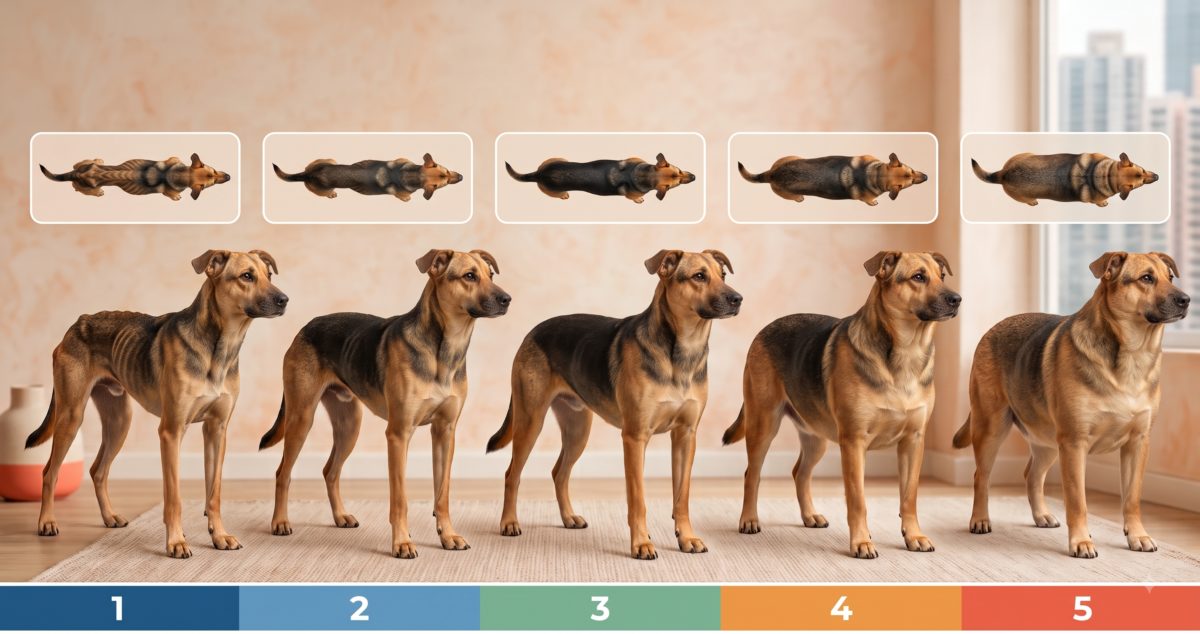
Your dog body condition score is the single most useful number for judging whether your dog is lean, ideal, or overweight—and you can estimate it at home in two minutes using the 9-point WSAVA scale and a simple look-feel-look check.
Bathroom scales tell you kilograms, but they cannot tell you whether those kilograms are muscle or fat, or whether they are right for your dog’s frame. A 20 kg Labrador and a 20 kg Border Collie can be at completely different stages of health. This guide teaches you how to read your dog’s body objectively, so you know when to act—and when your dog is exactly where they should be. (A companion guide covers the calorie maths for weight loss once you know your target.)
What is a dog body condition score?
A dog body condition score (BCS) is a standardised way to rate body fat by looking at and feeling specific landmarks. The WSAVA Body Condition Score chart uses a 9-point scale that any owner can apply:
- 1–3 (under ideal): ribs, spine and pelvic bones are visible or very prominent, with little or no fat cover and often visible muscle loss.
- 4–5 (ideal): ribs are easily felt under a thin layer of fat, the waist is clearly visible from above, and there is an obvious abdominal tuck from the side.
- 6–9 (over ideal): ribs become hard to feel under excess fat, the waist disappears, and fat is deposited over the lower back and tail base.
Each point above 5 represents roughly 10–15% over ideal weight, so a BCS of 7 means a dog is carrying about 20–30% too much. As a rough table-in-prose: a 5/9 dog is at ideal weight; a 6/9 is around 10–15% over; a 7/9 about 20–30% over; and 8–9/9 is clinically obese at 30–45% or more above ideal. The goal for most healthy dogs is a solid 4 to 5 out of 9.
The reason a score beats the scale is that it is proportional to your individual dog. Breed, age, and build all shift the “right” number of kilograms, but an ideal body condition score looks and feels the same across almost every dog: ribs you can feel, a waist you can see, and a belly that tucks up.
The look-feel-look method for scoring at home
You do not need a laboratory—just your hands and good light. The reliable way to estimate a dog body condition score is three quick checks:
- Feel the ribs. Run your palms flat along both sides of the chest. You should feel the ribs easily with only a thin fat layer over them—similar to feeling the back of your own hand. If you have to press to find them, that points to excess fat; if they feel sharp with no cover, the dog is too thin.
- Look from above. Stand over your standing dog and look down. A dog at an ideal score shows a visible waist—an hourglass that narrows behind the ribs. A straight or bulging outline means overweight.
- Look from the side. View your dog at eye level. The belly should tuck up from the bottom of the ribcage toward the hind legs. A belly that hangs level with or below the ribs signals excess weight.
Long or thick coats hide a lot, which is exactly why the hands-on rib check matters more than the eye test. When in doubt, trust what you feel over what you see.
A step-by-step at-home dog body condition score checklist
Work through these steps calmly, ideally when your dog is relaxed and standing squarely:
- Place both hands flat over the ribcage and note how much pressure you need to feel individual ribs.
- Slide your hands back to the lumbar (lower back) area and check for a fat pad over the spine and tail base.
- Stand over the dog and trace the waistline—is there a clear indentation behind the ribs?
- Crouch to the side and check the abdominal tuck from ribcage to hind legs.
- Match your findings to the 1–9 scale and write the number down with the date.
- Repeat every 2–4 weeks during any weight change, using the same person and method each time for consistency.
Recording the score, not just the weight, turns a vague worry into a trackable trend you can share with your vet.
Muscle condition score: a separate axis
Body fat is only half the picture. The AAHA muscle condition score is assessed independently of the dog body condition score, because a dog can be overweight and losing muscle at the same time—common in older dogs and in chronic disease. Muscle condition is graded as normal, or mild, moderate, or severe muscle loss.
You assess muscle by palpating over four bony areas: the skull (temporal bones), the shoulder blades, the spine, and the hip bones. Firm, well-padded muscle over these sites is normal; when the bones feel sharp and hollowed despite a heavy body, that is muscle loss masked by fat. Flag any muscle loss to your vet—it changes how a weight-loss plan should be built, because you want to strip fat while protecting lean mass.
This matters most in senior dogs. Age-related muscle loss (sarcopenia) can creep in even as the number on the scale stays the same or climbs, so a stable weight can hide a genuine loss of strength and function. Scoring muscle alongside your dog body condition score is the only way to catch it early—and the fix is usually adequate, high-quality protein rather than simply cutting calories.
Why body condition score matters for health and lifespan
Carrying extra weight is not cosmetic. Excess fat is biologically active tissue that promotes low-grade inflammation and loads the joints, and it is strongly linked to osteoarthritis, reduced exercise tolerance, and other chronic problems.
The most striking evidence comes from a 14-year lifetime study: in Kealy et al. (2002, JAVMA), Labradors kept lean (at an ideal body condition) lived a median of 1.8 years longer than their littermates fed 25% more, and showed later onset of chronic disease. Keeping a dog at an ideal body condition score is one of the few things an owner can do that measurably extends healthy life.
Just as important, extra weight makes existing problems worse. Every kilogram of fat adds load to hips, knees, and elbows, so an overweight dog with early arthritis feels stiffer and moves less—which burns fewer calories and drives further weight gain. Breaking that cycle often starts not with a supplement but simply with getting the dog body condition score back toward 4–5.
How to set a target body condition score with your vet
Your at-home estimate is the starting point; your vet turns it into a plan. A practical conversation covers:
- Confirming the current score. Vets score hundreds of dogs and will calibrate your reading—useful for heavily coated breeds.
- Ruling out medical causes. Conditions such as hypothyroidism or fluid retention can mimic or worsen weight gain and need treating first.
- Setting a target weight. From the current BCS your vet back-calculates a realistic ideal weight (roughly a 10–15% weight change per BCS point away from 5).
- Agreeing a safe pace. Steady loss of about 1–2% of body weight per week protects muscle and avoids rebound.
Never crash-diet a dog. Rapid, unsupervised restriction risks muscle loss and, in cats especially, serious liver problems—another reason a target should be set with professional input.
From assessment to feeding: weight management
Once you have a target score and weight, the next step is feeding the right number of calories in a food that keeps your dog full and preserves muscle. Weight-management diets are built to be lower in calorie density but higher in protein and fibre, so a dog can eat a satisfying portion while still running a calorie deficit. Work out the exact numbers in our dog weight-loss calorie calculation guide, and see how fresh food fits an everyday routine in the complete fresh dog food guide.
How Dogalicious fits in
If your vet agrees your dog would benefit from a lower-calorie, higher-protein diet, our Weight Management range is formulated for exactly that—gently reduced calories with enough protein to help protect lean muscle during weight loss. Always introduce any therapeutic diet under veterinary guidance.
- Weight Management — Turkey
- Weight Management — Chicken
- Weight Management — Fish
- Browse the full Weight Management range.
FAQ
How often should I check my dog’s body condition score?
Every 2–4 weeks during active weight change, and at least monthly otherwise. Use the same method each time so the trend is meaningful.
My dog is fluffy—how can I score accurately?
Ignore the coat and rely on the hands-on rib and lumbar check rather than the visual outline. Feeling the ribs through a thin fat layer is the most reliable single test.
Can a dog be overweight but still lose muscle?
Yes. Body condition (fat) and muscle condition are scored separately, so a dog can have a high body condition score yet show muscle loss—which is why both are worth checking, especially in senior dogs.