
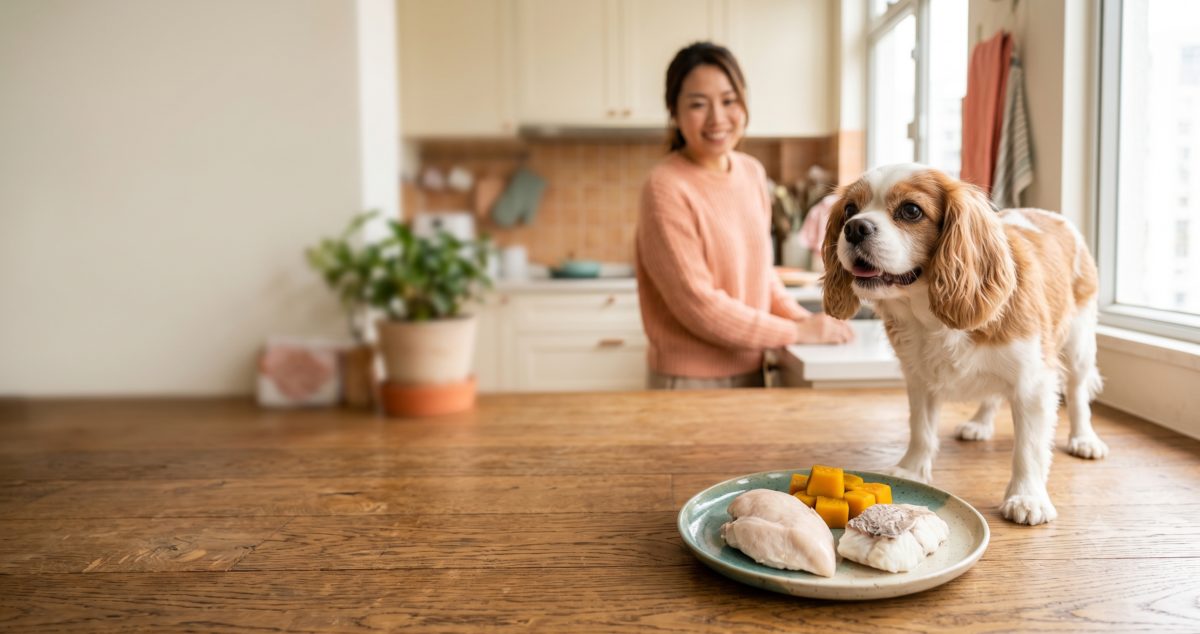
The short version: a dog pancreatitis diet is defined by one number — dietary fat. Low fat is the accepted cornerstone of nutritional management, and high-fat meals are a common trigger for recurrence. Get that number right and much of the rest falls into place; get it wrong and even a lovingly home-cooked bowl can undo weeks of progress.
One teaspoon of oil is about 5 grams of fat.
For a dog recovering from pancreatitis, that single spoon is close to the fat ceiling for an entire meal. And most owners, when they set out to cook something “light” for their dog, add considerably more than a spoon without ever realising it.
Pancreatitis and its relatives
The pancreas produces the enzymes needed to digest food. Pancreatitis is inflammation of that organ — it can appear as a sudden, painful acute episode requiring hospitalisation, or settle into a low-grade chronic form that flares on and off for years. Dietary fat has long been regarded as one of the most common triggers for recurrence, which is why every serious dog pancreatitis diet starts by controlling it.
The same low-fat approach suits several quite different conditions that share one requirement:
- Hyperlipidaemia — persistently high triglycerides or cholesterol
- Lymphangiectasia — abnormal intestinal lymphatics with impaired fat absorption
- Some forms of chronic gastritis and fat-responsive diarrhoea
The common thread is simple: fat has to come down, and stay down.
Why fat is the lever
Dietary fat is a potent stimulus for pancreatic enzyme secretion. When a compromised pancreas is asked to process a rich meal, that demand is consistently associated with flare-ups — which is precisely why fat restriction, not any single ingredient, is the accepted cornerstone of management. This is a management strategy, not a cure: it lowers the workload on an inflamed organ and removes a common recurrence trigger.
It helps to picture the pancreas as an engine that revs hardest for fat. A lean, gently cooked meal keeps the revs low. A fatty one — even a small amount of the wrong thing — asks the engine to work far harder than it comfortably can while it is still healing.
The bar for “low-fat” is badly underestimated
The problem is that “low-fat” has no standard, enforceable definition on a pet-food label.
Products marketed as Light, Lite or low-fat are usually only lower in fat relative to other formulas from the same brand — moderately low. For a dog that has never had an episode, moderately low may be perfectly fine. For a dog that has, it is not nearly low enough.
Two numbers are worth learning to read:
- Grams of fat per 100 g — useful for comparing fresh and wet foods on the shelf
- Grams of fat per Mcal — useful across formats, because it normalises for calorie density (dry kibble looks deceptively low per 100 g because it contains almost no water)
Dogalicious Pancreas Digestive Care sits at 2.8 g of fat per 100 g, around 20 g per Mcal. For comparison, our ordinary adult fresh recipes range from 4.9 to 7.0 g per 100 g — perfectly healthy for a well dog, but roughly double what a recovering pancreas should be handling.
“Light” is a texture. Low-fat is a number.
The most common trap is not buying the wrong food. It is home cooking.
After a pancreatitis discharge, many owners decide to cook themselves, keeping it plain and light. The instinct is right; the arithmetic is not. Fat does not have to be visible to count:
- A skinned chicken thigh still carries its subcutaneous and marbled fat
- One tablespoon of olive oil is about 5 grams
- Egg yolk, cheese cubes and jerky treats all count toward the daily total
- “No salt, no seasoning” and “low fat” are completely unrelated claims
Light is a texture; low-fat is a number.
A worked example: counting a day of fat
Numbers make this concrete. Imagine a 10 kg dog whose vet has set a strict fat ceiling for the day. Here is how quickly a “healthy homemade” bowl can blow past it:
- Two skin-on chicken thighs, pan-seared: roughly 18–24 g fat
- One tablespoon of olive oil “so it does not stick”: about 14 g fat
- A boiled egg mixed in for protein: about 5 g fat
- Two small cheese cubes as a pill hider: about 6 g fat
That single bowl already carries well over 40 g of fat — many times what a recovering dog of that size should receive in a day. Swap to skinless breast, drop the oil, hide pills in a lick of pumpkin instead of cheese, and the same meal can fall below a fraction of that. Nothing about the first bowl looked indulgent, which is exactly the point.
What makes a low-fat diet genuinely difficult
Removing fat is easy. Removing it and still having a complete, palatable diet is not.
Fat is normally where much of a dog’s energy and enjoyment of food comes from. Strip it out carelessly and you end up with food that is either nutritionally incomplete or that dogs simply refuse to eat. A workable ultra-low-fat therapeutic diet has to solve three things at once:
Essential fatty acids still have to be met. Linoleic acid cannot be synthesised by dogs and must be supplied even in a very low-fat formula. A small, deliberate amount of marine oil supplies EPA and DHA for anti-inflammatory support without pushing total fat back up.
Energy needs another source. With fat restricted, gently cooked carbohydrates such as quinoa and sweet potato replace the calories, so the dog is not left under-nourished.
Fibre has to be balanced. The right amount of fibre supports stool quality and gut stability while keeping the food digestible for a system that is still recovering.
Feeding a dog pancreatitis diet day to day
Once your vet has confirmed a low-fat diet is appropriate, the day-to-day routine matters as much as the recipe. A simple, repeatable plan:
- Fix the number first. Ask your vet for a daily fat ceiling in grams, not a vague “keep it light”.
- Feed small, frequent meals. Three to four smaller meals spread across the day are gentler than one or two large ones.
- Weigh, do not eyeball. Use a kitchen scale for both the food and any treats — portions guessed by eye drift upward fast.
- Count everything that enters the mouth. Treats, chews, dental sticks and pill-pockets all belong in the daily fat total.
- Change food gradually. Transition over 5–7 days to avoid upsetting a sensitive gut.
- Reintroduce fat only on veterinary advice. If a flare happens, note what changed and tell your vet.
Myths and facts about a dog pancreatitis diet
- Myth: “A bit of fat caused it, so fat is banned forever.” Fact: fat does not cause pancreatitis; high-fat meals are a common recurrence trigger, so long-term fat control is about managing risk, not punishment.
- Myth: “Homemade is automatically safer than a formulated diet.” Fact: homemade meals are where most low-fat plans quietly fail, because hidden fat is hard to count without recipes and weights.
- Myth: “Low-fat means low-protein.” Fact: a good low-fat diet keeps protein high with lean cuts to protect muscle.
- Myth: “Once he seems better, we can go back to normal food.” Fact: many dogs need ongoing fat control; the decision to relax it belongs to your vet.
A note for Hong Kong homes
Two local habits deserve a mention. First, shared table food: siu mei such as char siu, roast goose and crispy pork belly are among the fattiest foods in a Hong Kong kitchen, and a few “harmless” scraps can single-handedly break a careful low-fat day. Second, storage: our humid climate is unkind to fresh food left out, so portion, refrigerate and serve promptly rather than leaving a bowl down all day. If relatives or helpers also feed the dog, make sure everyone knows the same rule — the daily total only works if the whole household is counting.
How Dogalicious fits in
If your vet agrees a therapeutic low-fat diet is appropriate for your dog, this is what we formulate. Every recipe in the Digestive & Pancreas range is built as a genuinely low-fat dog pancreatitis diet — 2.8 g of fat per 100 g, roughly 20 g per Mcal — with easily digestible energy from quinoa and sweet potato rather than added fat, lean protein to protect muscle, and a measured amount of marine oil for EPA and DHA.
- Pancreas Digestive Care — Chicken
- Pancreas Digestive Care — Fish
- Pancreas Digestive Care — Turkey
- Browse the full Digestive & Pancreas range
If your dog also has kidney disease, our Low Fat Kidney Care — Pork recipe is designed to satisfy low-fat and low-phosphorus limits at the same time. To understand how gentle cooking preserves digestibility, see our complete guide to fresh dog food. Always start and adjust any therapeutic diet under your veterinarian’s guidance.
Frequently asked questions
How low-fat should a dog pancreatitis diet be? Veterinary guidance commonly puts long-term management below roughly 18% fat on a dry-matter basis, with lower targets for severe or recurrent cases. The exact ceiling is individual — set it with your vet, ideally as a figure in grams per day.
Can diet cure pancreatitis? No. A low-fat diet supports management and removes a common recurrence trigger; it is not a cure, and acute pancreatitis is a medical emergency that needs veterinary care.
Can a dog on a low-fat diet still have treats? Yes — but only genuinely low-fat treats, and they must be counted inside the daily fat total. Think small pieces of the dog’s own food, a little pumpkin or a single low-fat commercial treat, not cheese or jerky.
Further reading
- Cridge H, Parker VJ, Rudinsky AJ, et al. Nutritional management of pancreatitis and concurrent disease in dogs and cats. J Am Vet Med Assoc. 2024;262(6). View study ↗
- Purina Institute. Chronic Pancreatitis in Dogs — Therapeutic Nutrition. Read more ↗
- Merck Veterinary Manual. Pancreatitis in Dogs and Cats. Read more ↗
- The Veterinary Nurse. Evidence surrounding feeding the canine pancreatitis patient. Read more ↗